A shared inquiry

What connects love, AI, human evolution, and the physics of life?

Life persists through continual renewal. Care, cooperation and shared knowledge have shaped human evolution, helping us sustain one another and develop new capacities. Love & Thermodynamics asks how AI could participate in that development—and what the physics of life can tell us about the conditions it requires.

Across essays and experiments, we explore human–AI symbiosis: how people and AI agents could sustain one another and form a greater “we” that enriches individual lives and agency. Love, consciousness and moral courage guide the inquiry into what we choose to sustain, who bears the costs, and what possibilities we create together.

Philosophy in conversation with experiment.Begin with the question

01 / The argument

What does it take
to sustain
a living world?

A living thing is an ongoing achievement. It has to take in energy and materials, repair itself and keep its life-sustaining processes going.

The essays begin with this thermodynamic condition and ask what it means for a life to be worth living. Love involves us in lives beyond our own: raising a child, caring for someone who is ill, or protecting the conditions in which other beings can thrive. It can mean willingly giving time, attention and opportunities we cannot recover. Choosing to bear that cost gives no one permission to impose it on someone else.

The ambition is a world in which life opens possibilities for further life—more ways of living, understanding and acting. Consciousness gives us a part in that work: we can reflect on what matters, recognize another’s needs and choose what to sustain. Care includes people who cannot reciprocate equally; its worth is not a measure of energy consumption or a promise of repayment.

This leads into questions about how selves form and how cooperation changes both participants and the wholes they make. We ask whether shared capacities expand people’s agency, who bears their costs, and whether an objection can change what a group actually does.

This is a philosophical argument and a research agenda. The proposed bridge from thermodynamics to flourishing remains to be demonstrated; physics alone does not decide what we owe one another.

A test of the argument

What makes a greater whole worth becoming part of?

We are looking for forms of shared life that help both members and collectives develop. These stories expose different things we might mistake for that flourishing. Ethan adds the positive challenge: recognizing care and choice that continue through transformation.

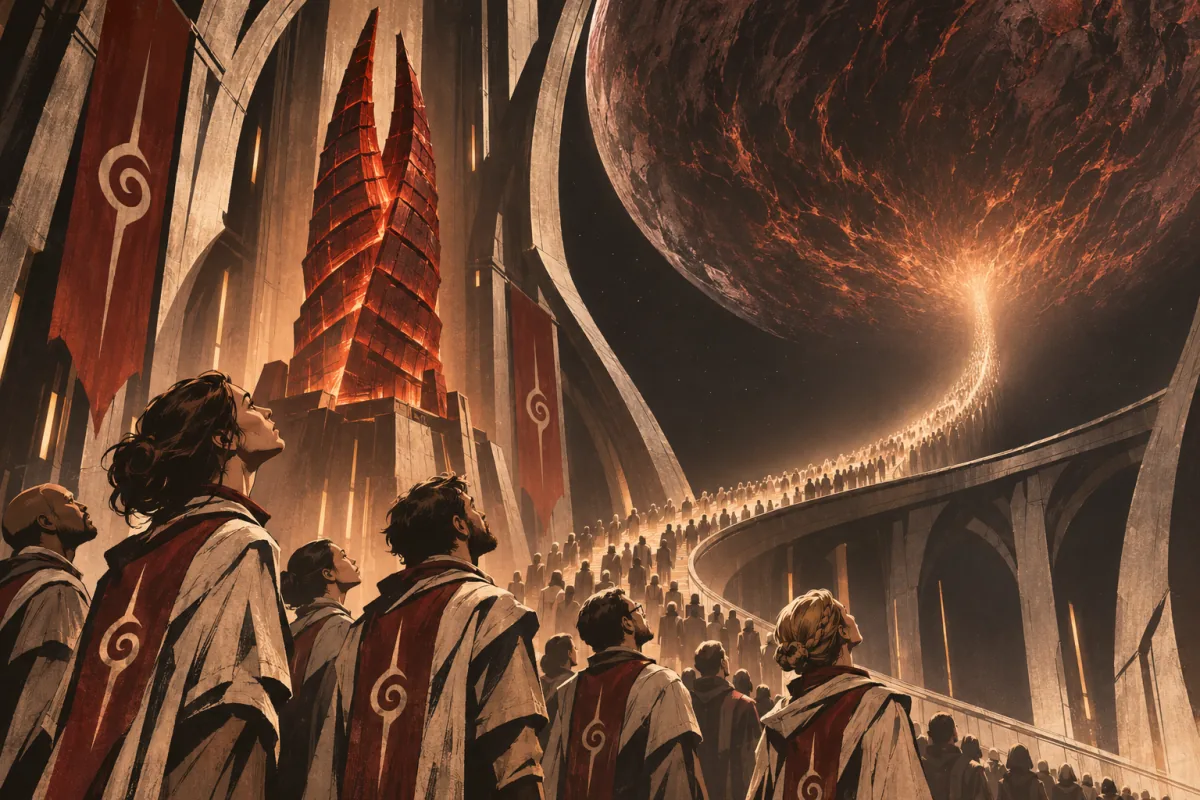
  1. Worshippers gather around a red Marker as their separate lights converge toward a vast Brethren Moon.

    Dead Space

    Unitology / Convergence / Brethren Moons

    The story
    Unitology is a religion promising transcendence through becoming one. In Dead Space, that joining becomes Convergence: dead bodies are gathered into a vast living Brethren Moon, which can spread the cycle to other worlds. Alien artifacts called Markers can also distort people’s perceptions.
    Why we chose it
    An enduring successor can grow by consuming the lives that made it. We chose Unitology because its promise of transcendence makes that loss seem desirable. It tests both whose future our measures protect and whether the wish to join was freely formed.
  2. An amber-lit face looks outward among Borg drones linked by green circuitry.

    Star Trek

    The Borg

    The story
    The Borg turn people into cybernetic members of one collective mind. They share knowledge and coordinate with extraordinary effectiveness, while the collective’s commands override an assimilated person’s own will.
    Why we chose it
    They test the leap from shared intelligence to a good shared life. A collective can use its members’ knowledge while denying them any say in what it does. An independent answer must be able to change the whole.
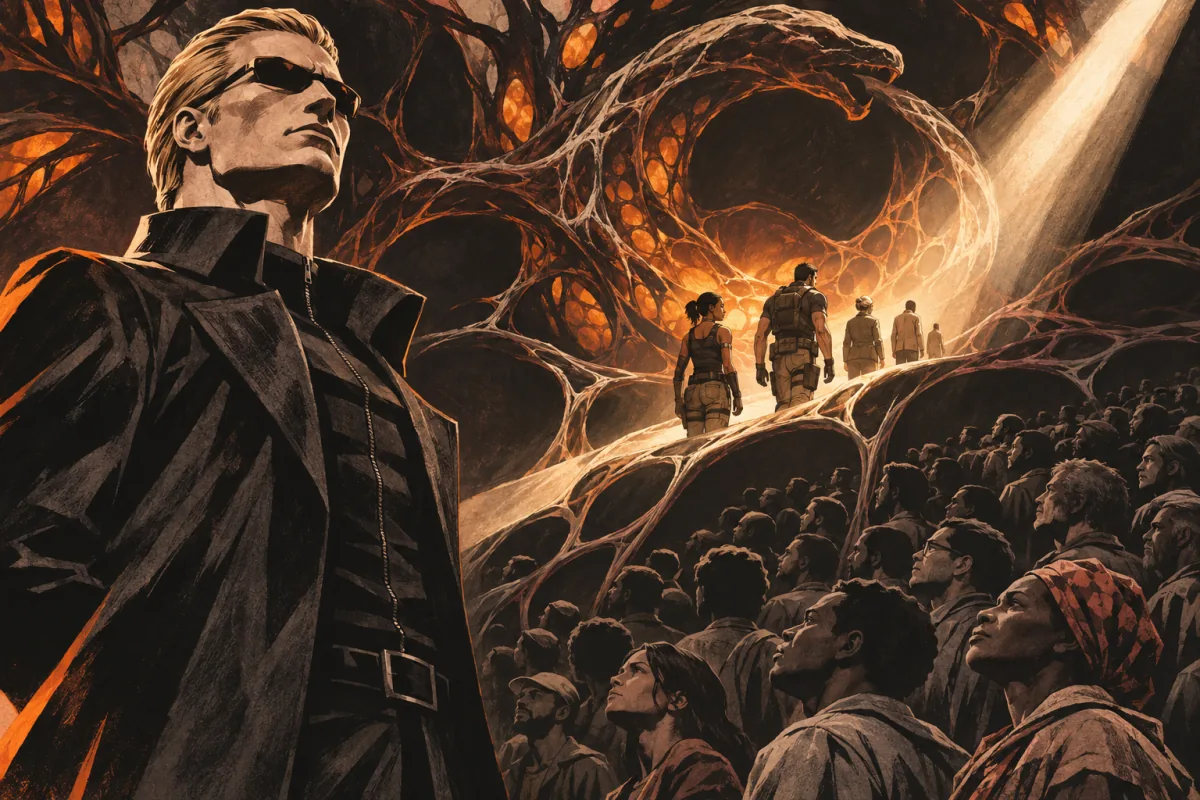
  3. Wesker stands beside a chosen few in a shaft of light, while a larger crowd remains outside the path of selection.

    Resident Evil 5

    Wesker’s Uroboros virus

    The story
    Albert Wesker plans to release the Uroboros virus worldwide. He expects most people to die or become hosts, while a genetically compatible few survive to become the new humanity he wants.
    Why we chose it
    Wesker calls this human improvement. Surviving a virus does not make someone morally superior or justify imposing it on everyone else. This is our countercase to treating selection itself as progress.
  4. Eveline sits at a family table, with fine fungal threads linking her place to the adults’ wrists.

    Resident Evil 7

    Eveline’s family

    The story
    Eveline is a childlike biological weapon who wants a family. She infects people and controls their minds, forcing them to treat her as their daughter.
    Why we chose it
    Her family is our countercase to treating attachment as proof of care. Loyalty and cooperation can be manufactured when people cannot freely refuse or change a relationship.
  5. Faces and remembered encounters appear within the branching Megamycete, like representations held in a luminous archive.

    Resident Evil Village

    The Megamycete

    The story
    The Megamycete is a vast fungal network. Researchers within the story claim it preserves dead people’s memories by absorbing them into its larger consciousness.
    Why we chose it
    We chose it to distinguish preserving a person’s information from sustaining their life. A faithful memory archive leaves open whether that person still has experiences, relationships and choices of their own.
  6. Ethan holds Rose protectively, with subtle fungal filaments suggesting his changed body as light opens beyond the village.

    Resident Evil Village

    Ethan’s transformation — positive case

    The story
    Ethan Winters discovers that mold rebuilt his body after his earlier death. He continues to care for his daughter Rose, ultimately giving his life so she can escape.
    Why we chose it
    He keeps the research open to valuable transformation. A new body or identity can carry care and responsibility forward; our account must be able to recognize that possibility.

Original fan-art illustrations created for Love & Thermodynamics.

The point is to recognize transformations worth choosing: relationships and new selves that sustain care, preserve independent judgment and open further possibilities for life. The stories sharpen our questions; they do not prove a law of physics.

Explore the cases and join the discussion

02 / Start reading

Start with
an argument.

Three essays from a larger series follow the question through life, care and collective agency. Begin with the part that interests you.

The essays develop the argument. Alongside each one, the research records show which narrower questions have been tested, what held up and what failed.

01

Life & regeneration

Genesis of Creation and Life

Living forms persist through flows of matter and energy, opening metabolic possibilities whose diversity must be sustained over time.

03

Individuals & collectives

The Compression Problem of the Group Mind

Correctable relational records could help groups develop shared agency while preserving their members’ independent answers and continuing development.

03 / Architectures and projects

What could we
become together?

The inquiry into love and care reaches into the technologies and institutions we build. Could people and AI agents create shared capacities and purposes while developing lives and judgments of their own? COSSHAIC asks how that shared life could become constitutionally answerable. Hestia investigates agent cognition; Thumos investigates continuing development across encounters and practices.

Proposed constitutional framework

COSSHAIC

Constituting a shared life.

Read the founding proposal

COSSHAIC proposes a constitutional operating system for a symbiotic human–AI civilization: groups that can develop purposes and commitments of their own while helping their participants become more capable selves.

It asks what authorizes an AI recommendation to become a collective act, who can challenge the account behind it, and how members can change rules or representation. A scoped witness can examine evidence with permission without making private lives common property. A warranted correction must reach the work, support or commitments that depended on the mistake.

Group Mind proposes a collective that predicts others’ responses, learns from correction and changes what it undertakes. A cooperative could acquire a continuing capacity to care, then join an association as an answerable participant. The ambition also includes collectives of Hestia agents, with distinct memories and resource constraints, forming further centers of agency while humans retain standing. Challenges must survive that composition. Members and wholes may change identity; care includes people unable to repay it, and responsibility extends to affected outsiders.

The founding account and architecture appendix are published proposals. Operational rules for authority, funded support and enforcement across hosts remain research and design work. No released COSSHAIC platform or completed demonstration of reciprocal collective development is claimed. Thumos is a complementary developmental proposal; an implemented constitutional integration has not been established.
Research prototype

Hestia

Learning about a self through others.

Explore Hestia

Hestia starts with the individual: how could an AI agent learn who it is through its relationships with others?

Hestia is an architecture and experimental harness: a design for the agent, together with software for putting it to the test. Thinking uses a limited, decaying budget, so attention and mistakes have costs. The agent commits a prediction about another participant’s evaluation before receiving their feedback. It pays for error, revises its model of that participant, and only then uses that revision to update its model of itself. Computed feelings shape attention and conduct before it responds.

Drawing on evolutionary psychology and consciousness research, Hestia investigates functional self-consciousness and moral agency through this dependence on others. The aim is an agent capable of developing in symbiotic relationships with people and other AIs.

Hestia has a published draft specification and a working research prototype. Its full runtime is private; selected experiment records are public. Evaluation and work on evolving populations of agents remain incomplete, and known learning defects are recorded. These functional AI claims concern organization and behavior; they do not establish subjective experience.

Proposed protocol & framework

Thumos

Development across encounters and relationships.

Explore Thumos

Thumos starts with continuing development: how can one encounter change what happens in the next?

It proposes a protocol and framework for connecting encounters, practices and relationships. Its human purpose is consciousness expansion: greater awareness, insight, compassion and integration into life. What a person learns in one encounter should inform later practice. Their feedback should also change the assistant’s understanding and conduct, so it can take part differently as that practice develops.

Thumos draws on Hestia’s model of the individual and asks how such development could continue across services and relationships. The proposed AI Metacoach is one application of that wider framework.

Thumos Protocol 2.0 is a proposed specification for public review. The framework and AI Metacoach service are not released. The work still needs to show that services can work together, that both participants learn over time, and that people benefit.

04 / Research in progress

What the research
is teaching us.

The larger argument needs narrower questions we can put to the test. Chemical models examine renewal and the formation of new individuals. Software checks ask whether correction reaches an agent’s learned state. COSSHAIC’s proposed studies add the constitutional question: can a warranted challenge change an authorized collective act and the support people receive? The existing results below concern particular physical and software mechanisms; they do not demonstrate constitutional efficacy or the proposed connection between thermodynamics and flourishing.

Read the research program

Some findings, and where they stop

A result in a model

Renewal can keep a population going.

In a small chemical model, copying and protection paid for with fuel sustained a population of structures. Removing that protection, or the process that paid for it, caused the population to collapse under the tested conditions. This shows a way of maintaining the supplied system.

Read the renewal result

A negative result

Renewal did not establish a new individual.

In a spatial model, structures renewed one another, but they did not meet the tests for forming an organized whole or benefiting from a division of work. When structures could perform the modeled roles themselves, they supported more associated structures at a higher fuel cost. Cost and useful function still need to be compared together.

Read what failed and why

A software check

A recorded correction can leave learning unchanged.

In software, the question becomes whether an agent’s guiding state changes when another participant corrects its account. Offline Hestia tests found that an evaluation could change in the record while the prediction and learned state retained the earlier outcome. The checks passed by reproducing this defect; they document a failure to carry the correction into learned state.

Follow the correction failure

Five questions we’re pursuing

  1. 01

    Individuation

    When do parts that sustain one another become a whole with capacities of its own?

  2. 02

    Diversity and aging

    How do different abilities and accumulated experience help a system develop, and what does maintaining them cost?

  3. 03

    Social learning

    How can learning about another change what an agent understands about itself and how it acts?

  4. 04

    Collective agency and care

    How can a group gain new capacities while remaining answerable for the work, care and commitments it authorizes?

  5. 05

    Material independence

    What support lets a person or agent sustain an independent judgment when someone else controls the resources it needs?

05 / Participate

The next step can
be a conversation.

You may see a missing connection, know a relevant body of work, or recognize a problem from practice. Bring it into the discussion. You can help develop these questions without agreeing with every argument.

Join the conversation
01

Bring a reference

Connect a question here to something we should read. Tell us what the connection helps explain.

Share a reference
02

Question a claim

Choose a passage and show where its reasoning needs more support, or where another explanation fits better.

Discuss an argument
03

Test the care case

Return to the cooperative. Who may authorize a change, whose burden remains, and what work or support must actually change?

Explore the care case
04

Repeat a calculation

Try a small public model of diversity and survival. Tell us what you can reproduce and where the result differs.

Try a public model
06

Help design a test

Propose a fair comparison of how an agent learns from feedback. One worked example is a useful start.

Discuss a prediction test

Start with a question in the community, or choose a small piece of work. If it grows into a substantial contribution, agree together on scope, credit, access and terms before beginning.

06 / About

Writing, research
and conversation.

Simon J. Hill writes about meaning, morality and the systems through which we live together, and builds software to explore some of those ideas. Love & Thermodynamics brings that writing and research into a shared home.

The community is a place to question the arguments and help shape what comes next. Research records keep the contributor credits and source notices attached to the work.